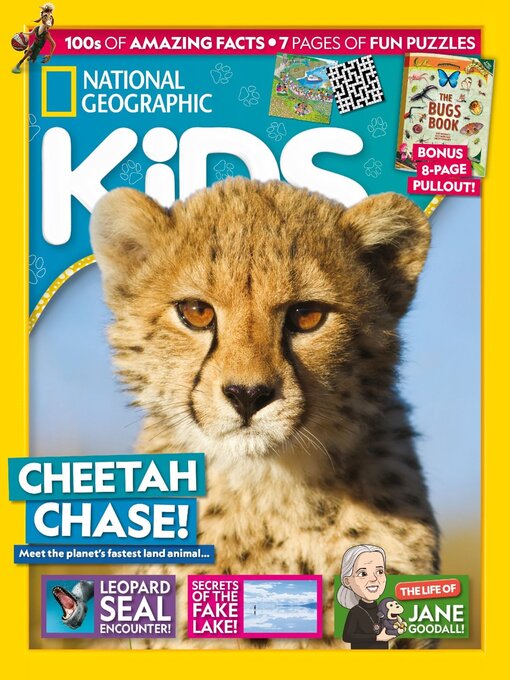
 Issue 141
 Issue 140
 Issue 139
 Issue 138
 Issue 137
 Issue 136
 Issue 135
 Issue 134
 Issue 133
 Issue 132
 Issue 131
 Issue 130
 Issue 129
 Issue 128
 Issue 127
 Issue 126
 Issue 125
 Issue 124
 Issue 123
 Issue 122
 Issue 121
 Issue 120
 Issue 119
 Issue 118
Perfect for nature-loving 7-12 year olds, each issue of Nat Geo Kids is carefully curated to ignite curiosity and spark conversations about science and nature, empowering children to love and care for our beautiful planet.
NATIONAL GEOGRAPHIC KiDS
WACKY WORLD! • The planet's strangest pictures…
COOL NEWS • Inspiring stories from around the globe…
Creature Feature CHEETAH • Meet the super-speedy sprinter that runs the savannah!
THE SEAL WHO LOVED ME • National Geographic Explorer Paul Nicklen tells us about an incredible underwater adventure in Antarctica…
FAKE LAKE • The world's largest salt flat creates a breathtaking illusion…
HOW THE SALT FLAT TOOK SHAPE
ANIMAL OLYMPICS • Discover which cold-weather creatures could go for gold in an animal version of the Winter Games!
THE BIG PICTURE • NAT GEO KiDS' image of the month
HISTORY'S GREATEST HITS
10 Brainy Questions • Hey, smarty-pants! Got big, weird questions? We've got answers!
JUNIOR EXPLORERS’ CLUB
FUN STUFF • GAMES LAUGH'S AND LOTS TO DO!
BRAIN TRAINING! • Boost your brain cells with our mind-boggling tests and challenges!
WHAT IN THE WORLD?
FUNNY FiLL-IN • Ask a friend to give you words to fill in the blanks in this letter without showing it to them. Then read it out loud for a laugh!
FUN STUFF MAKE IT
FUN STUFF ANSWERS
National Geographic Kids (AU/NZ)
SMURF BUG • We often give bugs common names that reflect things they resemble, such as the long-necked giraffe weevil. One of that insect's weevil relatives gets its common name of ‘Smurf bug’ from its bright blue colour. For many people, this bug reminds them of the small, blue, human-like Smurfs from comic books and television. There are many species in the genus Eupholus, and they share this same blue colour.
GIANT WĒTĀ • The giant wētās that live in New Zealand belong to the same insect family as crickets and grasshoppers, but they're super-sized! Although some crickets and grasshoppers have longer bodies, giant wētās are heavier. These nocturnal creatures eat plants, and some species also eat small invertebrates. Their name comes from the language of the indigenous Mãori people.
BRONZE ORANGE BUG • These small insects are also known as citrus bugs and stink bugs. Their mouthparts are adapted for piercing plants and sucking out the juices. And they have a fitting nickname, as they really do stink! When threatened, they can spray a smelly liquid at targets over half a metre away. This protects the bug against other arthropods or birds who might want to eat it.
HUNTSMAN SPIDER • Huntsman spiders are found throughout Australia. These large, longlegged spiders often give people a fright when they scuttle out from behind a curtain. There are many different species of huntsman, but the one shown here is one of the most unusual, and is often known as the communal huntsman. Social animals, they can be found living together in large colonies.
HONEYPOT ANT • Carpenter ants are found all over the world - there are more than 1,500 different species. One species, found only in Australia, is rather special! This ant lives in sandy regions of the continent, where large colonies often build their underground nests at the base of mulga trees. They are also known as ‘honeypot ants’ due to their ingenious way of storing food for the colony.
WEAVER ANT • Have you ever built a paper model, using glue to hold the pieces together? Weaver ants make their nests in a similar way, but they use leaves instead of paper, and produce the glue themselves! These aggressive ants live in large colonies of up to 500,000 individuals and are found in the tropical forests of Australia and Southeast Asia. They live and build their nests in...